













Best Kaabo Scooter for Back to School: A Model-by-Model Guide
Princeton extended its passing time between classes from 10 minutes to 15-20 minutes starting fall 2025, after university officials found that 750 to 800 students had back-to-back classes in buildings farther apart than the old schedule allowed. Campus size varies enormously from one school to the next, and that difference matters more than most students realize until move-in week. The best Kaabo scooter for back to school depends on an honest look at your own campus, not a generic "best scooter" list.
Michigan State University's main campus alone covers 5,200 acres with 100 miles of sidewalks, while plenty of smaller colleges fit entirely within a 10-minute walk end to end. A scooter that's perfect for one campus can be overkill, or not nearly enough, on another. Matching the model to the commute, rather than picking whichever one looks fastest, is what actually determines whether a scooter earns its price tag over four years of school.
This guide matches each of the five models currently discounted in Kaabo's back-to-school Sales and Deals lineup to the kind of campus and commute it actually fits, so the decision comes down to your own routine rather than guesswork. Each section below covers one scenario, from a short walk across a small quad to a multi-mile ride from off-campus housing, in roughly the order a typical commute grows over four years of school.
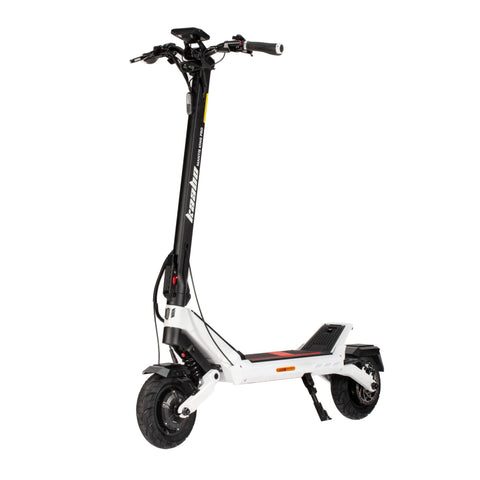
Quick Answer: The best Kaabo scooter for back to school depends mainly on campus size and daily distance. The Urban ($799) suits short walks on compact campuses, the Mantis 8 Lite ($899) and Mantis 10 Lite ($1,099) cover standard dorm-to-class routes, and the Mantis X Plus ($1,299) or Mantis King GT ($1,999) fit larger campuses, longer days, or off-campus commutes.
Best Kaabo Scooter for Back to School: Start With Your Campus
Campus footprint should drive the decision before price or top speed enters the conversation. A student walking between three buildings clustered around one quad has different needs than a student crossing a campus the size of a small town between classes. Neither situation calls for the same scooter, even though both are technically "commuting to class."
It's also worth checking your school's specific policy before buying anything. Most universities allow personal scooters with some restrictions on speed or parking, but a few have gone further: Princeton banned personal electric vehicles, including scooters and e-bikes, from campus in January 2025. A quick look at your school's transportation or housing policy page prevents an expensive surprise after move-in, since a policy change can happen with little warning between one semester and the next.
Once policy is confirmed, weight, range, and motor power become the real deciding factors. Someone riding six times a day between distant buildings needs more battery and torque than someone making one short trip from a nearby dorm. The sections below walk through each of the five current sale models in order, from the lightest and least expensive to the longest-range option in the lineup.
Short Walks and Small Campuses: The Case for the Urban
Students on compact campuses rarely need more than 25 miles of range or a heavier dual-motor build. The Urban, discounted to $799 from $999 in the current sale, covers that use case at 44 pounds, making it the easiest model in the lineup to carry up a dorm stairwell or tuck into a small room. That low weight also matters on move-in day, when a scooter is one more thing to carry alongside boxes and furniture.
A single 500W motor keeps the Urban light and simple, which suits flat, walkable campuses better than raw power ever would. Students who mainly ride between a handful of nearby buildings, or who split their commute between walking and riding depending on the weather, get the most value from the lowest-priced model in the sale rather than paying for range they won't use. Since it's also the cheapest option in this lineup, the Urban tends to make sense as a first scooter for students who aren't yet sure how much they'll actually ride once the semester gets underway.
Standard Commutes: Mantis 8 Lite vs. Mantis 10 Lite
Most students fall into this middle category: riding daily across a mid-sized campus, sometimes with a stop at a dining hall or library along the way. Both the Mantis 8 Lite and Mantis 10 Lite handle that routine comfortably, and the choice between them comes down to how much extra range and speed is worth the price difference.
Mantis 8 Lite for Budget-Conscious Daily Riders
The Mantis 8 Lite, discounted to $899 from $1,199, pairs dual 500W motors with a 25-mile range and a 25 mph top speed. The dual-motor setup adds stability and hill-climbing ability the single-motor Urban doesn't have, without stepping up to the higher price and larger battery of the 10 Lite.
Mantis 10 Lite for a Bit More Range and Speed
At $1,099 after the $300 discount, the Mantis 10 Lite bumps range to 37 miles and top speed to 31 mph on the same dual 500W motor configuration. That extra range matters most for students who ride to an off-campus job, a second campus building far from the main quad, or anyone who would rather charge every other day instead of nightly.
Both scooters weigh in the same general range, so the choice mostly comes down to how far a typical day actually stretches. A student who rides once or twice daily between nearby buildings won't notice the difference between 25 and 37 miles of range, while a student adding a part-time job or a second campus commute on top of classes usually appreciates the buffer the 10 Lite provides before the next charge.
Big Campuses and Longer Days: Mantis X Plus and Mantis King GT
Students commuting across the largest campuses, riding well past a mile each way, or combining class commutes with errands need more range and power than the standard lineup offers. Both models below cost more upfront, but the extra capacity means fewer charging interruptions during a packed semester.
Mantis X Plus for Extended Range
The Mantis X Plus, priced at $1,299 after a $400 discount, extends range to 46 miles while keeping the same 500W dual-motor format as the Lite models. That makes it a practical step up for students who want more range without moving into the heavier, more powerful Mantis King GT.
Mantis King GT for Maximum Power and Capacity
The Mantis King GT carries the largest discount in the current sale at $700 off, bringing it to $1,999 from $2,699. Its dual 1100W motors and 56-mile range suit students commuting from off-campus housing, riding across the biggest university campuses, or wanting the most headroom in the lineup for a four-year commute. The added motor power also helps on campuses with real elevation changes, where a lighter single-motor scooter can slow down noticeably on an incline.
Since the Mantis King GT sits at a higher price point than the rest of the lineup even after its discount, it tends to make the most sense for students who already know their commute is longer than average, rather than a first scooter bought without much information about the actual route ahead.
Comparing All Five Back-to-School Sale Models
Price, range, and motor power scale together across the lineup, so matching the model to the actual commute avoids both overspending and running short on range.
| Model | Discount | Sale Price | Motor | Range |
|---|---|---|---|---|
| Urban | $200 off | $799 | 500W | 25 mi |
| Mantis 8 Lite | $300 off | $899 | 500W×2 | 25 mi |
| Mantis 10 Lite | $300 off | $1,099 | 500W×2 | 37 mi |
| Mantis X Plus | $400 off | $1,299 | 500W×2 | 46 mi |
| Mantis King GT | $700 off | $1,999 | 1100W×2 | 56 mi |
All five models are part of the current Sales and Deals back-to-school pricing, with discounts ranging from $200 to $700 off list price. Notice that range roughly doubles from the Urban to the Mantis King GT while motor power more than doubles, which is why the price gap between the cheapest and most expensive model in this lineup runs to $1,200.
Working through the table left to right also doubles as a rough timeline of how a student's needs might change over four years. A first-year student on a small dorm-adjacent route often starts with the Urban or Mantis 8 Lite, then moves toward a longer-range model like the Mantis 10 Lite or X Plus once they're commuting from off-campus housing or juggling a part-time job across town.
That progression isn't a rule, though, since plenty of students stick with their first scooter for all four years without ever needing more range than the entry-level model provides. The table is meant as a reference point for matching a current routine to a current price, not a prediction of what a future semester will require.
Picking the Best Kaabo Scooter for Back to School Without Overthinking It
The decision gets simpler once campus size and daily distance are settled first. Most students overestimate how much range they need and underestimate how much a lighter, cheaper model like the Urban or Mantis 8 Lite covers a typical semester. Spending more upfront only pays off if the extra range or power actually gets used every week.
Start with your actual routine: count the buildings, estimate the distance, and check your school's scooter policy before comparing specs. From there, the five models above cover nearly every commute, from a short walk across a small quad to a multi-mile ride from off-campus housing. A student who isn't sure yet can also start with the cheaper Urban or Mantis 8 Lite and reassess after a semester of real riding data, rather than guessing at the higher end of the lineup from day one.
Every model in this guide is priced at its current back-to-school discount on the Sales and Deals page, so the comparison above reflects what you'd actually pay this semester rather than the original list price.
Frequently Asked Questions
Which Kaabo scooter is best for a small college campus?
The Urban fits most small campuses best, since its 25-mile range and 44-pound frame suit short, frequent trips between nearby buildings. On a compact campus, the decision usually comes down to weight and price rather than range.
Do I need a dual-motor scooter for college?
Only if your commute includes hills, longer distances, or daily round trips over a few miles. The single-motor Urban handles flat, short campus routes fine, while the dual-motor Mantis Lite and X Plus models perform better on hillier terrain or longer rides.
How much range does a college student actually need from a scooter?
Most students cover 2 to 5 miles a day between classes, meals, and errands, which the 25 to 37-mile range of the Urban and Mantis Lite models comfortably covers. Students commuting from off-campus housing or riding across large campuses benefit from the 46 to 56-mile range of the X Plus or King GT.
Are personal electric scooters allowed on college campuses?
Most campuses allow them with restrictions on speed, parking, or indoor use, but policies vary from one school to the next. Princeton banned personal electric vehicles, including scooters, in January 2025, so it's worth checking your specific school's transportation or housing policy page before buying rather than assuming every campus handles it the same way.
What's the price difference between the cheapest and most expensive back-to-school scooter?
The current sale spans $799 for the Urban to $1,999 for the Mantis King GT, a $1,200 difference driven mainly by motor power and range. The best Kaabo scooter for back to school within that range depends on how far and how often you actually plan to ride.