










Best Off-Road Electric Scooter for Adults: Kaabo's MAX Series Compared (2026)

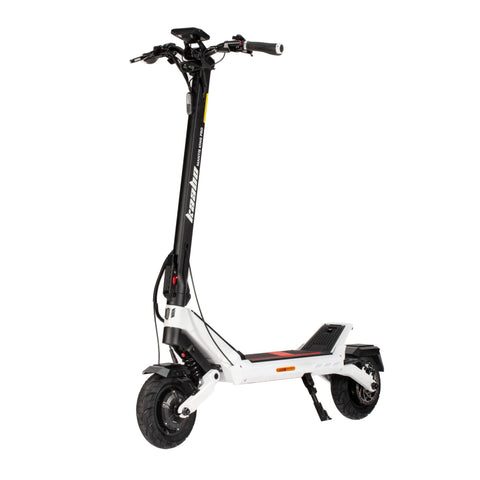
A 50-degree climbing angle and a 124-mile range put the Kaabo King GTR Max in a different class than the average commuter scooter. Most electric scooters top out at 15–20 mph and a 15–20 degree incline, which is fine for flat sidewalks but useless on gravel, hills, or backcountry trails. Riders searching for the best off-road electric scooter for adults need dual motors, real suspension travel, and a battery built for distance, not just a folding frame and a headlight.
Kaabo USA just dropped prices across its entire Warrior and King series for Labor Day, marking the first-ever price cut on the full MAX lineup. That makes this the right moment to compare what each model actually delivers, because "off-road" gets used loosely by scooter brands that never tested a machine past a paved bike lane.
This guide breaks down five off-road-capable Kaabo models by motor power, climbing angle, suspension, and battery range, then matches each one to the type of rider it fits best. Every spec below comes directly from Kaabo USA's own product listings, not marketing copy. By the end, you'll know exactly which model matches your terrain, your budget, and how far you actually need to ride.
Quick Answer: The best off-road electric scooter for adults combines dual motors over 1,000W, a climbing angle above 30 degrees, hydraulic suspension, and all-terrain tires. The Kaabo Warrior 11 Max delivers this balance at $2,499, with a 45-degree climb rating, 93-mile range, and 330-lb load capacity, while the King GTR Max leads the lineup for riders who want maximum power at $3,799.
What Makes a Scooter Off-Road Capable
An off-road electric scooter needs three things a city commuter model skips: a steep climbing angle, suspension travel measured in inches rather than millimeters, and tires wide enough to grip loose dirt or gravel. Without all three, a scooter labeled "all-terrain" will still bottom out on a rutted trail.
Climbing angle matters more than most buyers realize. The U.S. Access Board, which sets federal accessibility standards, treats a wheelchair ramp slope as steep once it exceeds roughly 8.3 percent grade, or about 4.8 degrees (Access Board, Chapter 4). An off-road scooter rated for a 30- to 50-degree climb is operating in territory far beyond any paved incline a rider will encounter in a city, which is exactly why that reserve capacity matters on dirt trails, wet grass, or loose gravel where traction drops.
Suspension design separates true off-road scooters from street models wearing knobby tires for looks. Hydraulic dual-shock systems with adjustable damping, like the setups on Kaabo's Warrior and King series, absorb impacts that a rigid or spring-only frame transmits straight into the rider's wrists and spine. Combined with 10- to 11-inch pneumatic or tubeless tires, this is what lets a scooter hold a line over roots and washboard gravel instead of skipping across it.
Best Off-Road Electric Scooter for Adults: Warrior and King MAX Series Compared
Kaabo's Warrior and King MAX-series models share the same design philosophy, dual high-torque motors, hydraulic suspension, and reinforced aluminum frames, but scale power and price differently. The table below lists verified specs for the five models currently included in Kaabo USA's Labor Day MAX Series price drop.
| Model | Motor | Top Speed | Range | Climbing Angle | Max Load | Sale Price |
|---|---|---|---|---|---|---|
| Warrior X Max | 1,100W × 2 | 44 mph | 56+ miles | 35° | 265 lbs | $1,799 (was $2,199) |
| Warrior X Plus | 1,100W × 2 | 44 mph | 44 miles | 35° | 265 lbs | $1,599 (clearance) |
| Warrior 11 Max | 1,500W × 2 | 50 mph | 93 miles | 45° | 330 lbs | $2,499 (was $3,199) |
| King GT Pro | 2,000W × 2 | 62 mph | 112 miles | 50° | — | $3,099 (was $3,999) |
| King GTR | 2,000W × 2 | 65 mph | 112 miles | 50° | — | $3,199 (was $4,199) |
| King GTR Max | 2,000W × 2 (13,440W peak) | 65 mph | 124 miles | 50° | 330 lbs | $3,799 (was $4,199) |
The Warrior X Max sits at the entry point of the off-road tier, and it's the model most riders should start with unless they specifically need extended range or higher top speed. Its 35-degree climb rating and UL-certified 60V 27Ah battery pack handle moderate trail grades and unpaved commutes without the added weight of the larger King-series frames.
Where the King Series Pulls Ahead
The King GTR Max carries a peak output of 13,440W across its dual 2,000W motors, roughly five times the continuous rating of the Warrior X Max. That power reserve translates into consistent torque on sustained climbs rather than a scooter that struggles once a hill gets steep. Its 72V 40Ah Samsung INR21700-50GB battery pack is also the largest in the lineup, which explains the 124-mile range figure at a 15 mph test speed.
Battery Range and Climbing Power for Trail Riding
Range figures on off-road scooters drop faster than on flat commuter routes because climbing and loose terrain demand more current from the motor. A 93-mile rating on the Warrior 11 Max assumes a 165-lb rider on flat ground at a steady 15 mph, so hilly trail riding will pull that number down meaningfully.
Torque, not just wattage, determines how a scooter behaves on an incline. The Warrior 11 Max produces 52 N·m of torque from its dual 1,500W motors, while the Warrior X Max produces 30 N·m from its 1,100W motors. Higher torque means the motor maintains speed under load instead of bogging down, which is the difference between climbing a grassy slope smoothly and stalling halfway up it.
Battery Cell Types Across the Lineup
Kaabo uses two primary cell suppliers across these models: Samsung INR21700-50GB cells in the King GTR Max, and DMEGC 21700 cells in the Warrior series. Both are name-brand lithium-ion cells rather than generic pouch cells, and the Warrior X Max's battery pack carries UL certification, a distinction worth checking on any scooter marketed for heavy off-road use. Independent testing bodies like UL Solutions evaluate personal e-mobility devices against safety and performance benchmarks that go beyond a manufacturer's own claims (UL Solutions, Personal e-Mobility Testing).
Suspension, Tires, and Brakes for Rough Terrain
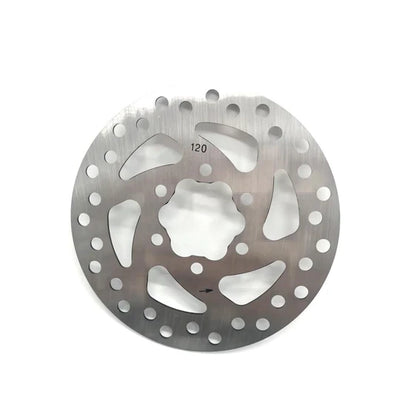
Every model in this comparison uses hydraulic disc brakes paired with an Electronic Anti-lock Braking System (EABS), a combination that shortens stopping distance on loose surfaces where a single mechanical brake would lock a wheel and skid. The King GTR Max upgrades this further with four-piston calipers and 160mm rotors front and rear, the largest braking setup in the lineup.
Suspension travel follows the same pattern as motor power: the bigger the scooter, the more travel it offers. The King GTR Max pairs a motorcycle-style dual-stem front suspension with a rear adjustable hydraulic shock, while the Warrior 11 Max offers 120mm of front travel with 15 levels of rear adjustment. Tire width also scales up the lineup, from the Warrior X Max's 10-by-3.0-inch all-terrain tires to the King GTR Max's 100-55-7 CST puncture-resistant tubeless tires, both designed to hold traction on dirt and gravel rather than just wet pavement.
For a deeper breakdown of how spring, hydraulic, and air suspension types compare, see our full electric scooter suspension guide.
Choosing the Right Off-Road Model for Your Budget and Riding Style
Matching a scooter to a rider comes down to three questions: how far you ride per trip, how steep the terrain gets, and how much weight the scooter needs to carry. A 165-lb rider commuting five miles over mixed pavement and gravel paths needs far less machine than a 250-lb rider planning weekend trail rides.
The Warrior X Max or the clearance-priced Warrior X Plus fits riders who want off-road capability without the higher price tag of the King series. Both share the same 1,100W dual-motor platform and 35-degree climb rating, with the X Plus trading roughly 12 miles of range for a lower price point.
Riders who need maximum load capacity and the longest range should look at the Warrior 11 Max or the King GTR Max, both rated to a 330-lb capacity. The Warrior 11 Max is the better value at $2,499, while the King GTR Max justifies its $3,799 price with a larger battery, four-piston brakes, and the highest peak power output in the comparison.
Before pushing any of these scooters beyond factory settings, it's worth understanding the real risks involved. Our article on the dangers of removing the speed limiter on an off-road electric scooter covers why factory-tuned power delivery exists in the first place, and our guide to maximizing electric scooter range explains how riding habits affect real-world mileage on any of these models.
The global electric scooter market is projected to keep growing through 2033, according to Grand View Research, driven partly by demand for higher-performance and off-road-capable models rather than only entry-level commuter scooters (Grand View Research, Electric Scooters Market). That shift toward power and durability is exactly what separates the Warrior and King series from lighter folding scooters built for sidewalks alone.
Frequently Asked Questions
What is the best off-road electric scooter for adults right now?
The Warrior 11 Max offers the strongest balance of power, range, and price for most adult riders, with a 45-degree climb rating, 93-mile range, and 330-lb load capacity at $2,499. Riders wanting maximum power should consider the King GTR Max at $3,799 instead.
What climbing angle counts as truly off-road capable?
A climbing angle of 30 degrees or higher generally indicates genuine off-road capability, since standard paved inclines rarely exceed 10 to 15 degrees. Kaabo's Warrior and King series scooters range from 35 to 50 degrees, well above what any city commute requires.
Do off-road electric scooters need dual motors?
Dual motors provide better traction on loose or uneven terrain because power distributes across both wheels instead of one. Every off-road model in Kaabo's Warrior and King series uses dual motors ranging from 1,100W to 2,000W per motor for this reason.
How much does suspension travel matter for trail riding?
Suspension travel absorbs impacts from roots, rocks, and uneven ground before they reach the rider's arms and spine. Hydraulic dual-shock systems, like those on the Warrior 11 Max and King GTR Max, handle rough terrain far better than the basic spring suspension found on commuter-focused scooters.
Is the Warrior X Max good for both city and off-road riding?
The Warrior X Max handles both environments well, with a 44 mph top speed for paved commutes and a 35-degree climb rating with all-terrain tires for unpaved paths. Its 265-lb load capacity and UL-certified battery make it a practical entry point into off-road-capable scooters.
Kaabo's MAX Series Makes Off-Road Power More Affordable This Labor Day
Choosing the best off-road electric scooter for adults ultimately comes down to matching motor power, climbing angle, and battery range to the terrain you'll actually ride. The specs in this guide, pulled directly from each product page, show that Kaabo's Warrior and King MAX-series models scale predictably: more motors, more suspension travel, and more battery capacity as the price climbs.
With the first-ever price drop across the entire MAX Series now live, models that previously started near $3,200 begin at $1,799, and the flagship King GTR Max has dropped to $3,799. That makes this a practical window to move up from a commuter scooter into something built to handle gravel, hills, and unpaved trails without hesitation.
Full specs, current pricing, and financing options for every model in this comparison are available on the Kaabo USA Labor Day Sale page.