













Kaabo Mantis vs Warrior: Side-by-Side Comparison

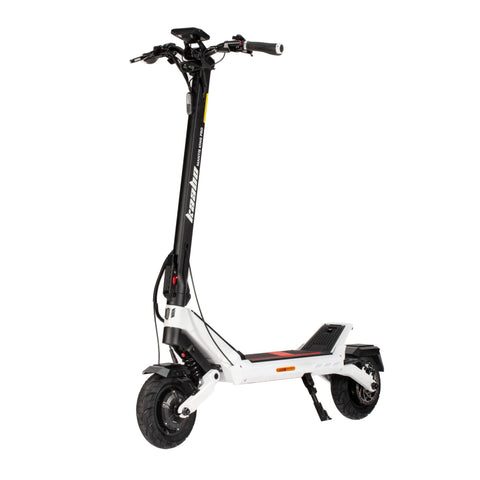
The kaabo mantis vs warrior decision comes down to one fundamental question: do you need a scooter that fits your life, or a scooter that dominates terrain? Both families share Kaabo's engineering standards — forged aluminum frames, hydraulic brakes, and dual motor drivetrains. But they target completely different riders, and choosing the wrong one creates daily friction that specs alone don't predict.
The Mantis lineup spans five models from the lightweight Urban to the performance-focused Mantis King GT. It prioritizes manageable weight, fast charging, and city-to-trail versatility. The Warrior and King lineup covers six models — from the Warrior X Plus to the King GTR Max — and prioritizes raw output, heavy rider support, and off-road durability above all else.
This comparison covers both families clearly. By the end, you'll know which lineup matches your actual riding life — and which specific model within that lineup to buy.
Quick Answer: The Kaabo Mantis series suits daily commuters and versatile riders who want lighter machines, faster charging, and manageable weight between 55–77 lbs. The Warrior and King series suits performance and off-road riders who need higher motor output, larger battery capacity, and 330 lb load support at 90–115 lbs machine weight. Both use hydraulic disc brakes, dual motors, and forged aluminum alloy frames.
Kaabo Mantis vs Warrior: How the Two Lineups Differ
The Mantis and Warrior families share a manufacturer but serve different rider profiles. Mantis models prioritize portability, daily practicality, and efficient range. Warrior models prioritize peak power, terrain dominance, and heavy-rider capability. The specs reflect that split clearly across motor output, battery size, and machine weight.
The Mantis lineup starts with the Kaabo Urban — Kaabo's lightest commuter — and builds through the Mantis 8, Mantis 10 Lite, Mantis X Plus, and up to the Mantis King GT. Each step up adds motor power and battery capacity while keeping the design focused on urban utility.
The Warrior family starts with the Warrior X Plus and Warrior X Max, progresses through the Warrior 11 Pro+ and Warrior 11 Max, and reaches peak output with the King GT Pro, King GTR, and King GTR Max. Each model in this family adds output and capacity at the cost of additional weight.
Shared Engineering Standards
Both families use 6061-T6 and 6082-T6 aviation-grade aluminum alloy frames with front and rear hydraulic disc brakes. Both run dual brushless hub motors with sine wave controllers. Both include LED lighting systems, foldable designs, and TFT or LCD displays. The shared platform means build quality is consistent — the differences are deliberate specification choices, not quality gaps.
Full Spec Comparison: Mantis King GT vs Warrior 11 Pro+ vs King GT Pro
The three top-tier models in each family illustrate the clearest performance differences between the lineups.
| Specification | Mantis King GT | Warrior 11 Pro+ | King GT Pro |
|---|---|---|---|
| Motor Output | 1100W × 2 (2200W) | 1200W × 2 (2400W) | 2000W × 2 (4000W) |
| Peak Power | Not rated | 5400W | 8400W |
| Top Speed | 43 mph | 50 mph | 62 mph |
| Real-World Range | 37 miles | 50–60 miles | ~55 miles |
| Optimal Range | 56 miles | 93 miles | 112 miles |
| Battery | 60V 24Ah (21700 cells) | 60V 35Ah (LG MJ1 18650) | 72V 35Ah (21700) |
| UL Certification | Yes | No | No |
| Brakes | ZOOM Hydraulic + ABS | Hydraulic 160mm + ABS | Hydraulic 160mm + ABS |
| Suspension | Dual Adjustable Hydraulic | Hydraulic + C-Spring | Hydraulic + C-Spring |
| Climbing Angle | 30° | 45° | 50° |
| Max Load | Not specified | 330 lbs | 330 lbs |
| Weight | ~77 lbs | 101 lbs | 115 lbs |
| Charge Time (dual ports) | 2.5 hours | ~8 hours | ~11.6 hours |
| Frame Design | Standard stem | Dual stem forged | Dual stem forged |
| IP Rating | IPX5 | Not rated | IPX7 (display) |
The dual stem forged frame design in the Warrior and King family deserves specific attention. A dual stem distributes structural load across two parallel uprights, which significantly increases rigidity under heavy rider loads at speed and during off-road landings. The Mantis King GT uses a single stem frame — still forged from the same alloy grade, but better suited to the lighter loads and smoother terrain it targets.
Mantis Series: Built for City Riding and Versatile Commuters
The Mantis lineup builds from a core philosophy: make a scooter capable enough for performance riders but practical enough for daily use. Every model in the range reflects that balance between output and usability.
The Mantis 8 and Mantis 10 Lite handle typical urban commutes — flat roads, moderate hills, and occasional rougher paths. Both run dual motors for confident acceleration in traffic. The Mantis 10 Lite adds wheel size for slightly better obstacle clearance, while the Mantis 8 focuses on compact folded dimensions for riders who need to carry or store the machine in tight spaces.
Mantis X Plus: The Mid-Range Sweet Spot
The Mantis X Plus steps up motor output and battery capacity for riders who want more performance without reaching the Mantis King GT's weight and price. It suits suburban riders with longer commutes and occasional light off-road use — the type of riding where the Urban or Mantis 8 would fall short on range but the King GT would be overkill on power.
Mantis King GT: The Top of the Mantis Line
The Mantis King GT represents the full Mantis philosophy executed at its peak. Dual 1100W motors hit 43 mph. The UL-certified 60V 24Ah battery using 21700-format cells delivers 37 miles of honest real-world range. ZOOM hydraulic disc brakes front and rear provide consistent stopping force. And the dual adjustable hydraulic suspension — both wheels independently adjustable — lets riders tune damping stiffness for different surfaces.
The 2.5-hour full charge via dual ports sets the Mantis King GT apart from every Warrior and King model. That charging speed changes what's possible in a day. You can top up during a work shift, a lunch break, or a gym session. No Warrior or King model offers that — their charge times run 8–11.6 hours for a full cycle.
Warrior and King Series: Built for Off-Road Performance and Heavy Riders
The Warrior and King family starts where the Mantis line ends. Every model in this range targets riders who need more power, more range, and more structural strength than any Mantis can provide.
The Warrior X Plus and Warrior X Max serve as the entry points into this family — high output, off-road capable, and engineered around the dual stem frame that defines the Warrior identity. Both handle terrain that would stress a Mantis model. Moving up through the Warrior 11 Max and Warrior 11 Pro+ adds battery capacity and load rating.
Warrior 11 Pro+: The Off-Road Benchmark
The Warrior 11 Pro+ defines the Warrior lineup's purpose. Dual 1200W motors peak at 5400W combined — enough to push a 330 lb rider to 50 mph and climb 45-degree inclines. The 60V 35Ah LG MJ1 18650 battery provides 50–60 miles of real-world range and 93 miles under optimal conditions. That's the highest range figure in the entire Kaabo USA lineup.
Motorcycle-grade inverted hydraulic front shock absorbers and a rear C-spring unit handle repeated off-road impacts without bottoming out. The T6082 one-piece forged aluminum dual stem distributes landing forces across two structural uprights. At 101 lbs, it demands accessible storage — but for riders who have that, no scooter in this price range matches its combination of range, load capacity, and trail performance.
King GT Pro and King GTR Max: The Performance Ceiling
The King GT Pro and King GTR Max represent the top of Kaabo's production lineup. The King GT Pro runs dual 2000W motors peaking at 8400W, reaches 62 mph, and covers the 0–30 mph sprint in 3.8 seconds. The King GTR and King GTR Max push specifications further still — built for riders who have outgrown everything else in the catalogue.
These machines are not daily commuters. They're purpose-built performance platforms that reward experienced riders willing to manage their weight, charging demands, and the heightened attention that 60+ mph riding requires.
Which Lineup Is Right for You: Kaabo Mantis vs Warrior Decision Guide
The choice between the Mantis and Warrior families reduces to four factors: weight tolerance, charging availability, primary terrain, and rider weight.
Choose the Mantis series if you commute in an urban or mixed environment, need to charge at work or during the day, ride primarily on roads with occasional light trails, and prefer a machine under 80 lbs that folds for transport or storage. The Mantis King GT covers the full range of that profile at peak capability.
Choose the Warrior or King series if you ride off-road regularly, carry above 200 lbs, need sustained range above 40 miles per charge, or want top speed above 43 mph. You'll also need overnight charging access and secure storage — none of these machines suit stair-heavy transport or casual carry situations.
For riders between the two profiles — urban primary, occasional off-road, moderate range needs — the Mantis King GT's adjustable suspension and 43 mph capability covers more ground than its classification suggests. It handles 30-degree inclines, gravel paths, and highway speeds without the weight and charging commitment that the Warrior 11 Pro+ demands.
Frequently Asked Questions
What is the main difference between the Kaabo Mantis and Warrior?
The kaabo mantis vs warrior difference centers on weight, power, and intended terrain. Mantis models run 55–77 lbs with dual motors up to 2200W, targeting urban and mixed-terrain riders with fast charging. Warrior and King models run 90–115 lbs with up to 8400W peak output, targeting off-road performance and heavy riders needing 330 lb load capacity.
Is the Kaabo Mantis King GT good for off-road riding?
Yes, with reasonable expectations. The Mantis King GT handles packed dirt, gravel, and light trails well. Its dual adjustable hydraulic suspension and all-terrain tires provide genuine off-road capability up to 30-degree inclines. However, it doesn't match the Warrior 11 Pro+'s 45-degree climbing, 101 lb structural mass, or motorcycle-grade inverted front suspension for aggressive trail riding.
Which Kaabo scooter has the best range?
The Warrior 11 Pro+ delivers the highest range in the Kaabo USA lineup — up to 93 miles under optimal conditions and 50–60 miles at realistic commuting speeds. The King GT Pro follows at 112 miles optimal but roughly 55 miles at speed. The Mantis King GT provides 37 miles real-world range. In the kaabo mantis vs warrior comparison, the Warrior family leads on range at every tier.
How much does the Kaabo Mantis King GT weigh compared to the Warrior 11 Pro+?
The Mantis King GT weighs approximately 77 lbs. The Warrior 11 Pro+ weighs 101 lbs — a 24 lb difference. That gap matters in two situations: moving the scooter without riding it, and handling at low speeds in tight spaces. For riders who need to carry or store the scooter regularly, the Mantis King GT's weight is a practical daily advantage.
Does the Warrior 11 Pro+ charge faster than the Mantis King GT?
No. The Mantis King GT charges fully in approximately 2.5 hours using dual charging ports simultaneously. The Warrior 11 Pro+ takes approximately 8 hours with two chargers. In the kaabo mantis vs warrior comparison, charging speed is the Mantis family's clearest daily-use advantage. The Warrior's larger 60V 35Ah battery stores more energy — but it takes significantly longer to replenish.
Which Kaabo scooter is best for heavy riders over 250 lbs?
The Warrior 11 Pro+ and King GT Pro both support a 330 lb maximum load. For heavy riders, these Warrior and King family models are the right choice — their dual stem forged frames, inverted hydraulic front suspension, and higher-torque motors handle the additional load without performance degradation. Mantis models don't publish a 330 lb rating and suit lighter riders more comfortably.
Make the Right Choice Between Mantis and Warrior Before You Buy
The kaabo mantis vs warrior decision is clearer than most comparisons make it seem. Both families deliver genuine build quality and dual-motor performance. They simply do it for different riders and different use cases.
The Mantis line wins on practicality. Faster charging, lower weight, and urban-first engineering make it the right choice for daily riders who want performance without the overhead that comes with machines built for extreme terrain. The Mantis King GT sits at the top of that argument — versatile, quick to charge, and capable enough for most riders who think they need a Warrior.
The Warrior and King line wins on capability. If you ride trails, carry significant weight, or want the range and power ceiling that the Mantis family doesn't provide, the Warrior family delivers it. The Warrior 11 Pro+ and King GT Pro represent the performance ceiling of what personal electric scooters currently offer.
Still comparing across the full range? Browse the complete Kaabo USA electric scooter lineup to see every model side by side and find the right fit for your budget and riding profile.