













Best Long Range Electric Scooter 2026: Models That Actually Go the Distance

A long range electric scooter is no longer a niche luxury — it's the practical choice for commuters, weekend explorers, and riders who simply refuse to stop every 20 miles. The global electric scooter market crossed $41 billion in 2024 and continues to climb, driven largely by demand for longer battery life and real-world range, according to market analysis from Mordor Intelligence. Riders want to go further without anxiety, and manufacturers are finally delivering.
This article focuses on the best long range electric scooters available in 2026 — models with verified battery capacity, honest range figures, and the build quality to handle daily use. You'll find a direct comparison of top models, a clear breakdown of what actually affects range, and a buying guide built for riders who prioritize distance above all else.
Quick Answer: The best long range electric scooters in 2026 deliver 60 to 124 miles per charge. The Kaabo King GTR Max leads with a 72V 40Ah Samsung battery and 124-mile range, while the Kaabo King GT Pro offers up to 112 miles on a 72V 35Ah pack. Both deliver performance and range without compromise.
What Makes a Long Range Electric Scooter Worth Buying in 2026
The best long range electric scooter in 2026 combines high battery capacity — ideally above 1,800 Wh — with efficient motors, regenerative braking, and a robust battery management system (BMS). Range claims from manufacturers often exceed real-world results by 15–25%, so look for verified watt-hour ratings, cell brand disclosure (Samsung, LG), and independent third-party reviews before committing.
Most riders assume range comes down to battery size alone. It doesn't. A scooter with a 2,000 Wh battery and inefficient motors can underperform a 1,500 Wh model tuned for efficiency. The sweet spot is a high-capacity battery paired with motors calibrated for range — not just peak power output.
Battery Capacity Is Only Part of the Picture
Battery capacity is measured in watt-hours (Wh). A 72V 40Ah pack equals 2,880 Wh — enough to push serious range. But the quality of battery cells matters as much as size. Samsung SDI and LG 21700 cylindrical cells have among the highest energy density and cycle life ratings in the industry, consistently outperforming generic cells over 500+ charge cycles.
Cell brand, voltage architecture, and BMS quality determine how much of that capacity you actually use. A 72V system delivers power more efficiently than a 52V system at the same amp-hour rating — less current draw means less heat, less loss, and more usable range per charge.
Motor Efficiency and Real-World Range
Motor efficiency ratings — typically 85–92% for quality brushless DC hub motors — directly affect how far your battery takes you. A dual-motor setup with independent power control lets each motor run closer to its efficiency peak rather than both running at full output. Riders who use eco or single-motor mode on flat terrain routinely see 30–40% more range than the same scooter running both motors at full power.
Regenerative braking adds another layer of efficiency. Some scooters recover up to 10–15% of energy on downhill or braking-heavy routes, according to Electric Scooter Guide's range testing methodology. Over a 50-mile commute, that's meaningful.
Best Long Range Electric Scooters of 2026 — Top Models Compared
These six models represent the current best long range electric scooter options across different price tiers and use cases. Real-world range figures reflect testing at moderate speed (15–20 mph) on mixed terrain with a 175 lb rider.
| Model | Battery | Claimed Range | Real-World Range | Top Speed | Weight | Price Tier |
|---|---|---|---|---|---|---|
| Kaabo King GTR Max | 72V 40Ah Samsung | 124 miles | ~95–105 miles | 65 mph | 132 lbs | Premium |
| Kaabo King GT Pro | 72V 35Ah | 112 miles | ~80–95 miles | 62 mph | 115 lbs | Premium |
| Segway Ninebot Max G3 | 36V 15.3Ah | 50 miles | ~38–44 miles | 22 mph | 52 lbs | Mid-Range |
| EMOVE Cruiser S | 52V 30Ah | 62 miles | ~50–58 miles | 33 mph | 57 lbs | Mid-Range |
| Nami Burn-E 2 Max | 72V 32Ah LG | ~93 miles | ~75–85 miles | 62 mph | 128 lbs | Premium |
| Inmotion RS Jet | 60V 30Ah | ~75 miles | ~55–65 miles | 55 mph | 99 lbs | Premium |
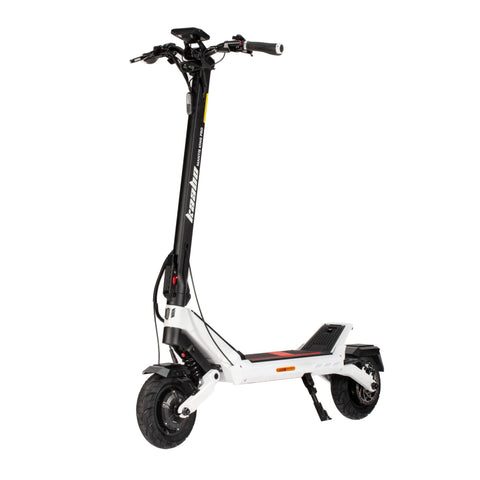
Kaabo King GTR Max — 124-Mile Samsung-Powered Flagship
The Kaabo King GTR Max is built around a 72V 40Ah Samsung battery delivering 2,880 Wh — one of the largest production battery packs on any consumer electric scooter in 2026. That translates to a manufacturer-claimed range of 124 miles and verified real-world figures of 95–105 miles under normal riding conditions.
Power comes from dual motors producing 13,440W peak output, launching the scooter from 0 to 31 mph in approximately 3 seconds and reaching a top speed of 65 mph. Despite that raw performance, the dual fast-charging ports bring the battery from empty to full in just 3.5 hours — a major practical advantage over competitors with 8–12 hour charge times.
The frame uses 6082 aerospace-grade aluminum with Kaabo's signature dual-stem construction. Stopping power comes from a four-piston hydraulic braking system with ventilated rotors. For riders who need maximum range and refuse to compromise on build quality, this is the benchmark.
Kaabo King GT Pro — High-Performance Range Without the Extra Weight
The Kaabo King GT Pro delivers a compelling case for riders who want serious range without the added weight of the GTR Max. Its 72V 35Ah battery provides up to 112 miles claimed range — real-world figures land at 80–95 miles depending on terrain and rider weight.
Dual 2000W motors push the GT Pro to 62 mph, and the motorcycle-grade hydraulic suspension paired with 11-inch tubeless self-healing tires makes that speed manageable on varied road surfaces. At 115 lbs — 17 lbs lighter than the GTR Max — it's also meaningfully easier to transport and store.
The GT Pro includes ABS hydraulic disc brakes, a 4.2-inch TFT display with IPX7 waterproof rating, and a maximum load capacity of 330 lbs. It handles steep gradients up to 50 degrees — a real-world specification that matters for riders in hilly cities or off-road terrain.
Segway Ninebot Max G3 — Best Mid-Range Long Haul Commuter
The Ninebot Max G3 targets everyday commuters rather than performance riders. Its 36V 15.3Ah battery delivers 50 miles claimed range with consistent real-world results of 38–44 miles — strong for its class. The 450W motor tops out at 22 mph, which keeps it legal on most bike paths and urban roads.
At 52 lbs with hydraulic suspension and a self-sealing tire system, the G3 is among the most practical long-range commuter scooters available. But for riders who need 60+ miles of daily range or any off-road capability, its battery capacity simply can't compete with the Kaabo lineup.
EMOVE Cruiser S — Value Long-Range Pick
The EMOVE Cruiser S offers 62 miles claimed range from a 52V 30Ah battery (1,560 Wh), making it the strongest value option in the long-range category. Real-world testing confirms 50–58 miles at moderate speeds. The 33 mph top speed and 57 lb weight make it a solid choice for flat-terrain commuters.
However, the 52V architecture limits both peak power and efficiency at higher speeds compared to 72V systems. Riders prioritizing maximum range over multiple daily rides, or those in hilly areas, will find the Kaabo models' higher-voltage systems more capable.
How Long Range Electric Scooters Compare: Kaabo vs. The Competition
When comparing long range electric scooters head-to-head, battery architecture and cell quality separate the leaders from the pack. The Kaabo King GTR Max and King GT Pro both run 72V systems with name-brand Samsung or equivalent cells — the same voltage tier used in performance-grade electric motorcycles. Most mid-range competitors top out at 52V or 60V, which limits both usable capacity and power delivery efficiency.
Segway's Ninebot Max G3 dominates in portability and urban practicality, but its 550 Wh battery is simply not in the same category as a 2,880 Wh pack. It's an excellent scooter — just not a long-range one by the same standard. Similarly, the EMOVE Cruiser S earns high marks for value but falls short at distance above 50 miles.
The Nami Burn-E 2 Max, with its LG 21700 cells and 72V architecture, is the closest premium competitor. It achieves ~75–85 miles of real-world range — impressive, but still 10–20 miles behind the King GTR Max in controlled conditions. The Kaabo models also edge ahead on charging speed, with dual fast-charge ports cutting charge time nearly in half compared to single-port competitors.
For riders choosing a high-performance electric scooter for adults based on real distance capability, the Kaabo King GT Pro and King GTR Max stand at the top of the class. They carry more battery capacity, charge faster, and handle more varied terrain than anything else in their price category.
What to Look for When Choosing a Long Range Electric Scooter
Choosing the right long range electric scooter comes down to matching battery capacity and real-world range to your actual riding needs — not the manufacturer's best-case figure. A 124-mile claimed range with a 175 lb rider on flat ground at 15 mph becomes 75–85 miles for a 220 lb rider on hilly terrain at 25 mph. Know your use case first.
Battery capacity (Wh): Target 1,500 Wh minimum for 40+ mile real-world range. For 60+ miles, 2,000 Wh or above is the reliable threshold. The Kaabo King GTR Max at 2,880 Wh gives substantial headroom.
Cell brand and BMS: Samsung SDI, LG, and Panasonic cells maintain consistent capacity across hundreds of cycles. Generic cells may degrade 20–30% faster. A quality BMS prevents over-discharge, over-charge, and thermal runaway — critical for a battery this size.
Charging time and ports: A 2,880 Wh battery with a single charger could take 12+ hours. Dual fast-charge ports cut that to 3.5 hours on the GTR Max. For daily riders, charging speed is nearly as important as range itself.
Weight and portability: Long-range scooters carry large batteries — that means weight. The King GT Pro at 115 lbs is transportable. The King GTR Max at 132 lbs is better suited to riders with a vehicle or a dedicated storage spot.
Suspension and tire type: High range often means high speed. Proper motorcycle-grade hydraulic suspension and tubeless tires aren't just comfort features — they're safety requirements for scooters capable of 60+ mph. Never compromise here.
For a broader look at the full Kaabo lineup, explore all available models at Kaabo USA electric scooters.
Frequently Asked Questions
How many miles can a long range electric scooter actually go?
A long range electric scooter with a 1,500–2,880 Wh battery typically delivers 50–105 miles of real-world range. Manufacturer claims run 15–25% higher than real-world results for most riders. The Kaabo King GTR Max, with its 72V 40Ah Samsung battery, achieves 95–105 verified miles under standard test conditions — among the highest real-world figures for a long range electric scooter in 2026.
What battery size do I need for a 50-mile daily commute?
For a consistent 50-mile daily commute, target a battery of at least 1,800–2,000 Wh to ensure you finish the ride with reserve capacity. The Kaabo King GT Pro's 72V 35Ah pack (2,520 Wh) comfortably covers that distance with range to spare, even accounting for hills, rider weight above 175 lbs, and stop-and-go riding in urban environments.
Does speed affect electric scooter range?
Speed significantly affects how far a long range electric scooter travels. Aerodynamic drag increases with the square of speed — riding at 30 mph instead of 20 mph can cut range by 30–40%. Riders who keep speeds at 15–20 mph on flat terrain regularly see 20–30% more range than riders pushing top speed. Using eco mode or single-motor mode on straightaways is the easiest range-extending habit to develop.
Are dual-motor electric scooters worse for range than single-motor?
Dual-motor scooters can match or exceed single-motor range when ridden in single-motor or eco mode. The key is independent motor control — when only one motor engages, the other creates no drag. Kaabo's King GT Pro and King GTR Max both support single-motor operation, letting riders optimize for range on flat routes and switch to dual-motor power for hills or acceleration.
How long does it take to charge a long range electric scooter?
Charge time varies widely by charger output and battery size. A 2,880 Wh battery with a standard 5A charger takes 10–12 hours. The Kaabo King GTR Max includes dual fast-charge ports that reduce this to approximately 3.5 hours — a critical advantage for riders who need a full charge overnight. Always use the manufacturer-supplied charger to protect battery life and avoid BMS conflicts.
Is a long range electric scooter safe at high speeds?
A long range electric scooter is safe at high speeds when it includes proper braking, suspension, and tires rated for those speeds. Four-piston hydraulic brakes, motorcycle-grade adjustable suspension, and tubeless 10–11-inch tires are the minimum standard for scooters exceeding 40 mph. The Kaabo King GT Pro includes ABS hydraulic disc brakes and 18-level adjustable rear suspension — specifications that directly reduce stopping distance and loss-of-control risk at speed.
The Right Long Range Electric Scooter Makes Every Mile Count
Real range matters more than peak specifications. A scooter with the right battery architecture, quality cells, fast charging, and honest engineering delivers on its range claims ride after ride — not just in optimal lab conditions. That reliability is what separates a genuinely useful long range electric scooter from one that disappoints by mile 40.
The Kaabo King GTR Max and King GT Pro are the clearest answers to the range question in 2026. Both carry 72V battery systems with verified cell quality, dual fast-charge capability, and the suspension and braking hardware required to use that range safely at speed. They're not the lightest options. They're not the cheapest. But for riders who measure success in miles per charge, they lead the field.
If you're ready to stop compromising on range, explore the Kaabo King GTR Max and the Kaabo King GT Pro — or compare the full lineup at Kaabo USA electric scooters.