













Electric Scooter Tire Guide: Replacement and Maintenance

A flat tire at the wrong moment doesn't just ruin your morning — it can be genuinely dangerous. Whether you're a daily commuter relying on your scooter for the last mile or a weekend rider clocking serious mileage, your tires are the single point of contact between your machine and the road. Getting scooter tire replacement right matters more than most riders realize.
Electric scooter tires take a beating. Road debris, heat, uneven surfaces, and inconsistent inflation all accelerate wear. Most riders don't think about their tires until something goes wrong. But staying ahead of tire maintenance keeps you safe, extends your scooter's range, and saves you money on repairs that could have been avoided.
This guide covers everything you need to know: the three main tire types, how to read the warning signs, a step-by-step scooter tire replacement walkthrough, and the maintenance habits that keep tires rolling longer. Whether you ride a Kaabo Warrior, a Mantis, or any other high-performance scooter, this guide applies directly.
Quick Answer: Scooter tire replacement is needed when tread depth is visibly worn, the tire shows cracking or bulging, or flats become frequent. Most pneumatic tires last 1,000–3,000 miles; solid tires can last 2,000–5,000 miles. Match the replacement tire to your scooter's exact size spec, deflate completely before removal, and use tire levers for safe installation. Most replacements take 30–90 minutes.
What Type of Scooter Tire Do You Have?
Before any tire work, you need to know exactly what type of tire your scooter uses. The procedure, tools, and cost differ significantly between types. There are three main categories, and each has a distinct profile.
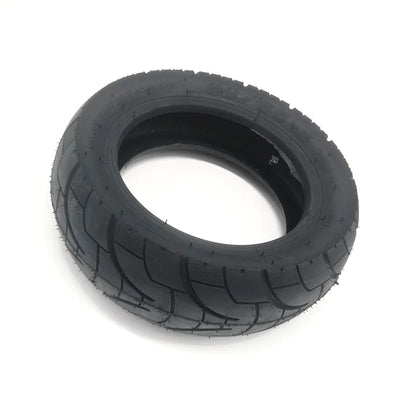
Pneumatic tires with inner tubes are the most common on performance scooters. They use a separate rubber inner tube that holds air, wrapped by a tougher outer tire. These offer excellent shock absorption and a smooth ride. The tradeoff is puncture vulnerability — a nail or sharp edge can flat the tube quickly. Patching or replacing the inner tube usually costs $5–$15, and a full tire swap runs $15–$40 depending on size and brand.
Tubeless pneumatic tires work like car tires: no inner tube, with the outer tire forming an airtight seal directly against the rim. They're more puncture-resistant than tubed tires and easier to seal with liquid sealant if they do get a slow leak. Several premium Kaabo models use this design because it combines ride quality with lower maintenance. Repair is harder if you do get a full flat, but the overall durability is better.
Solid (airless) tires are made from dense rubber or polyurethane foam. They never go flat — period. That's the main advantage. But solid tires weigh 20–40% more than pneumatic equivalents, which reduces acceleration and can cut battery range. The ride is noticeably stiffer, especially on rough urban roads. Solid tires also can't be repaired; when they wear out, they must be replaced entirely.
A fourth option — honeycomb tires — uses a cellular air-pocket structure rather than a sealed air chamber. They sit between solid and pneumatic in terms of comfort and puncture resistance, and are found on some mid-range scooters like the Unagi Model One.
Tire Type Comparison
| Feature | Pneumatic (Tubed) | Pneumatic (Tubeless) | Solid | Honeycomb |
|---|---|---|---|---|
| Flat risk | High | Medium | None | None |
| Ride comfort | Excellent | Excellent | Stiff | Moderate |
| Maintenance | Regular pressure checks | Occasional sealant | None | None |
| Typical lifespan | 1,000–3,000 mi | 1,500–3,500 mi | 2,000–5,000 mi | 2,000–4,000 mi |
| Repairability | Yes (tube patch) | Yes (sealant) | No | No |
| Weight | Lightest | Light | Heaviest | Heavy |
When Is Scooter Tire Replacement Actually Necessary?
The clearest sign is tread wear — but it's not the only one. Knowing all the warning signals helps you catch problems before they become safety hazards. Don't wait for a blowout on a busy road.
Tread depth is your primary visual indicator. New tires have a clear, deep tread pattern. When that pattern flattens out or disappears in sections, grip drops significantly — especially in wet conditions. Bald spots on electric scooter tires aren't just cosmetic; they reduce the tire's ability to channel water and maintain contact with the surface.
Look for these specific signs:
- Visible bald patches where the tread has worn smooth
- Cracks or dry rot along the sidewall or tread face — a sign the rubber compound is degrading
- Bulges or deformations on the tire surface, which indicate internal structural failure
- Repeated flats — if you're patching the same inner tube more than twice, it's time for full scooter tire replacement
- Reduced range without obvious battery issues — worn tires create more rolling resistance, forcing the motor to work harder
Most experts recommend replacing pneumatic tires every 1,000–3,000 miles, though actual wear depends heavily on terrain, rider weight, and braking habits. Hard braking on rough surfaces can cut tire life in half. Heavier riders on high-performance scooters like the Kaabo King GT should inspect tires more frequently given the higher loads and speeds involved.
How to Replace Electric Scooter Tires: Step-by-Step
Scooter tire replacement takes 30–90 minutes depending on tire type and experience. With the right tools and careful technique, it's a manageable DIY task for most riders.
Tools You'll Need
For pneumatic (tubed) tires:
- Tire levers (plastic, 2–3 pieces)
- Valve core removal tool
- Pump with pressure gauge
- Adjustable wrench or Allen key set
- Soapy water in a spray bottle
For solid tires:
- Tire levers (heavy-duty metal)
- Rubber mallet
- Bead breaker tool (for stubborn installations)
- Long lever arm or pry bar
Step-by-Step Process (Pneumatic Tubed Tires)
Step 1: Remove the wheel. Power off the scooter completely. Flip it onto a stable surface or use a stand. Use your wrench or Allen key to loosen all bolts holding the wheel in place. Note the position of any washers or spacers before removing them — photograph the assembly if you're not familiar with it.
Step 2: Deflate fully. Use a valve core removal tool to fully deflate the tire. A completely flat tire is much easier to work off the rim. Don't try to start with a partially inflated tire.
Step 3: Break the bead. Apply soapy water along the seam where the tire meets the rim. Insert a tire lever between the tire bead and the rim edge, prying the bead over the rim edge. Work two levers around the tire, moving in small increments. Take your time — rushing causes pinch flats in the new tube.
Step 4: Remove the old tube and tire. Once the bead is off one side, pull out the inner tube. Then work the entire tire off the rim. Inspect the inside of the rim for any sharp edges or debris that could puncture the new tube.
Step 5: Install the new tire and tube. Partially inflate the new inner tube just enough to give it shape. Seat one bead of the new tire on the rim, insert the tube, then work the second bead over the rim edge using levers. Ensure the tube is not pinched between the bead and the rim at any point.
Step 6: Inflate and check. Inflate to the PSI listed on the tire's sidewall — typically 40–65 PSI for most electric scooters. Spray the soapy water solution along the bead seam to check for leaks; bubbling indicates an air escape. If there are no leaks, reattach the wheel and torque all bolts to spec.
Step 7: Test ride slowly. Always test at low speed in a clear area before riding normally. Listen for unusual vibrations or handling irregularities that might indicate improper seating.
Notes for Solid Tire Replacement
Solid tires require more force and patience. The rubber is extremely rigid, and seating the bead correctly often requires a rubber mallet and prying leverage. Some configurations require professional assistance — particularly rear-wheel motor-hub tires on performance scooters. If the tire won't seat after 20 minutes of effort, stop and consult a shop rather than force it.
Scooter Tire Sizes: Getting the Right Fit
Installing the wrong size tire causes handling problems, rim damage, and in worst cases, accidents. Size matching is non-negotiable.
Tire sizes on electric scooters follow a standard format. A marking like 8.5 x 2 means 8.5 inches in diameter and 2 inches wide. Some tires use metric format: 50/75-6.1 represents the width, aspect ratio, and rim diameter. Both formats appear on tire sidewalls and in your scooter's owner manual.
The most common sizes on popular scooters:
- 8.5 x 2 inches — standard on the Xiaomi M365, GoTrax GXL V2, and many entry-level scooters
- 10 x 2.75 inches — common on mid-range commuter models
- 11 x 3.5 inches — found on performance scooters including several Kaabo models
- 13 x 5 inches — used on heavy-duty off-road scooters
Always verify your tire size against your owner manual before purchasing. Aftermarket tires should also match the ply rating — the number of reinforcement layers in the tire construction. Higher-ply tires handle heavier loads and provide better puncture resistance, which matters for riders above 200 lbs or on rough terrain.
Tire Pressure and Ongoing Scooter Tire Maintenance
Proper tire pressure is the single most impactful maintenance habit a scooter rider can develop. Underinflated tires wear faster, handle poorly, and significantly increase flat risk. Overinflated tires reduce grip and make the ride uncomfortably harsh.
Check tire pressure every two weeks if you ride daily, or before any long ride. Use a pump with a calibrated gauge — never rely on feel. Cold tires give the most accurate reading; checking after a ride results in artificially high readings due to heat expansion.
Other maintenance habits that extend tire life significantly:
Rotate your tires periodically. Swapping front and rear tires every few hundred miles distributes wear more evenly. The rear tire typically wears faster due to motor torque and weight bias.
Inspect visually after every ride. Look for embedded glass, nails, or debris. Remove foreign objects carefully using pliers before they work deeper into the rubber. A slow leak caught early is a $5 tube patch; ignored, it becomes a $40 tire replacement.
Apply tire sealant as a preventive measure. For tubeless pneumatic tires, a quality sealant like Slime or Stans NoTubes can seal punctures up to 1/4 inch automatically. This is especially useful for city riders who cross debris-heavy routes regularly.
Store correctly. Keep your scooter out of direct sunlight when not in use. UV radiation degrades rubber compounds steadily, causing premature cracking. A cool, dry storage spot indoors or under a UV-resistant cover extends both tire life and overall scooter longevity.
Frequently Asked Questions
How often should I do a scooter tire replacement?
Most pneumatic scooter tires need replacement every 1,000–3,000 miles, while solid tires typically last 2,000–5,000 miles. However, mileage is only one factor. Inspect tires monthly for visible wear, cracking, or bald spots — any of these signs require immediate scooter tire replacement regardless of mileage. Riding style and terrain affect lifespan significantly.
Can I put solid tires on a scooter designed for pneumatic tires?
Generally, no. Converting from pneumatic to solid tires usually requires different rim compatibility and may affect the hub motor clearance. Some aftermarket solid tire options exist for popular models like the Xiaomi M365, but the installation is demanding and significantly changes the ride character. Check your scooter manufacturer's guidance before attempting this modification.
What PSI should I inflate my electric scooter tires to?
The correct tire pressure is printed on your tire's sidewall, typically between 40–65 PSI for most adult electric scooters. Heavier riders should inflate toward the upper end of the recommended range. Always measure pressure when tires are cold — a post-ride reading is typically 5–10 PSI higher than the true cold inflation level, which can lead to underinflation in use.
How long does scooter tire replacement take at home?
A straightforward pneumatic tire replacement takes 30–60 minutes for a rider with basic mechanical experience and the right tools. First-timers should plan 60–90 minutes. Solid tire replacements take longer — sometimes 90+ minutes — and may require more specialized tools. Factor in setup and cleanup time, and do not rush the final inspection steps.
What tools do I need for electric scooter tire replacement?
The core toolkit for scooter tire replacement includes plastic tire levers, a valve core removal tool, an adjustable wrench or Allen key set, and a pump with a pressure gauge. A soapy water spray bottle helps detect leaks post-installation. For solid tires, add a rubber mallet and a long lever arm. Investing in proper tools upfront prevents rim damage and speeds up future repairs.
When should I go to a shop instead of replacing tires myself?
Take your scooter to a professional if the tire is seated on a hub-motor wheel (especially the rear drive wheel), if you've attempted solid tire replacement and can't seat the bead, or if the rim itself appears bent or damaged. Hub-motor rear wheels involve the electrical drivetrain — improper reassembly can damage motor windings or disconnect phase wires. Shops that specialize in e-bikes or electric scooters are the best option.
Good Tires Mean a Safer, Better Ride Every Time
Tires are the foundation of your scooter's performance. They affect braking distance, handling stability, battery range, and ride comfort. A worn or poorly maintained tire doesn't just slow you down — it creates real safety risk for you and everyone around you.
The good news is that scooter tire replacement and maintenance are learnable skills. With the right information and a basic set of tools, you can handle most tire work at home and stay ahead of problems before they strand you. Make tire inspection a habit, not an afterthought.
For riders running high-performance scooters, the tire spec matters as much as the motor spec. The Kaabo Warrior and King GT are built for serious riding — and they deserve tires that can keep up. Explore the full range of electric scooters and accessories at Kaabo USA to find compatible replacement tires and maintenance gear built for your specific model.

 https://www.facebook.com/KaaboUSA/


