













Mantis King Pro vs Apollo Phantom 2.0: Which Wins for the Money?

The Kaabo Mantis King Pro costs $1,599. The Apollo Phantom 2.0 starts near $1,994 and climbs past $2,130 for the hydraulic-brake trim. That price gap frames the entire Mantis King Pro vs Apollo Phantom decision.
Both scooters share the same core recipe: dual 1200W motors, a 2400W nominal output, 10-inch pneumatic tires, and a foldable frame built for daily riding. So on paper, they look like near-twins. In practice, though, they split on price, braking hardware, battery design, and how each one fits into everyday life.
The Phantom 2.0 rides a little faster and carries a heavier rider. The Mantis King Pro answers with a lower price, a removable battery, hydraulic brakes as standard, and a higher-voltage 60V system. Each choice points to a different kind of buyer.
This comparison breaks down motor power, battery and range, brakes, suspension, water resistance, weight, and total cost. It uses specs published by Kaabo alongside independent testing of the Phantom as of September 2026. Prices shift often, so confirm current figures before you buy.
By the end, you will know which scooter matches your budget, your commute, and your storage setup.
Quick Answer: In the Mantis King Pro vs Apollo Phantom 2.0 matchup, the Mantis King Pro wins on value. It costs about $400 less at $1,599, adds a removable 60V battery, and includes hydraulic brakes as standard. The Phantom 2.0 counters with a faster 41 mph top speed and a higher 300-lb rider limit, so speed-focused riders may still prefer it.
Mantis King Pro vs Apollo Phantom: Full Spec Comparison
The Mantis King Pro and Apollo Phantom 2.0 match closely on motor size and weight. But the Mantis King Pro leads on price, voltage, braking hardware, and battery access, while the Phantom 2.0 leads on top speed and rider capacity. The table below lines up both scooters spec for spec.
| Spec | Kaabo Mantis King Pro | Apollo Phantom 2.0 |
|---|---|---|
| Price | $1,599 | $1,994–$2,136 |
| Motor | Dual 1200W (2400W nominal) | Dual 1200W (2400W nominal) |
| Peak power | 3,360W | 3,200W |
| Battery voltage | 60V | 52V |
| Battery | 60V 18Ah (DMEGC 21700), removable | 52V 23.4Ah (~1,217Wh), fixed |
| Top speed | 37 mph | 41 mph (tested) |
| Range | Up to 50 mi (Kaabo test) | ~37 mi (tested, range mode) |
| Brakes | Front/rear 140mm hydraulic + EABS | Dual disc + regen (mechanical base) |
| Suspension | 132mm adjustable spring, F/R | Quad spring, adjustable tension |
| Tires | 10 x 3.0 in pneumatic | 10 x 3.25 in pneumatic |
| Net weight | 75 lbs | 77 lbs |
| Max load | 265 lbs | 300 lbs |
| Water rating | IPX5 body / IPX6 battery | IP54 |
| Fast charge | 2–2.5 hrs (dual chargers) | ~12 hrs (single) |
| Warranty | Up to 18 months | 12 months |
Overall, the numbers show two scooters built to a similar formula but tuned for different priorities. The Mantis King Pro chases value and everyday convenience. The Phantom 2.0 chases outright speed.
Motor Power, Voltage, and Top Speed
The Apollo Phantom 2.0 is the faster scooter, hitting a tested 41 mph against the Mantis King Pro's 37 mph. Both run dual 1200W motors and a 2400W nominal output, so the gap comes from tuning rather than motor size. The Mantis King Pro answers with a higher-voltage 60V system and a slightly stronger 3,360W peak.
Voltage matters more than most spec sheets suggest. The Mantis King Pro's 60V architecture delivers steadier power under load, which helps on hills and during quick launches from a stop. Its 25A dual controller feeds both motors evenly, so riders reach cruising speed fast in the city. Kaabo rates the climbing angle at 16 degrees, enough for standard urban grades.
The Phantom 2.0, meanwhile, runs a 52V system and pushes past 41 mph in independent testing. That extra 4 mph appeals to riders who want open-road speed. For most commuters, though, 37 mph already exceeds nearly every legal street limit, so the Mantis King Pro rarely holds a daily rider back.
Both scooters carry more than enough torque for real-world riding. If your priority is outright top speed, the Phantom 2.0 edges ahead. If you want stronger low-end pull and steadier power, the Mantis King Pro's 60V setup makes the better case. Either way, a dual-motor electric scooter suits riders who climb hills or carry extra weight.
Battery, Range, and the Removable-Pack Advantage
The Mantis King Pro's headline advantage is its removable 60V 18Ah battery, which the Phantom 2.0 cannot match. Kaabo builds the pack around a mechanical key-lock release, so riders pull it out and charge it indoors without lifting the whole scooter. The Phantom 2.0's larger 52V 23.4Ah pack sits fixed inside the deck.
On range, the two land closer than the spec sheets suggest. Kaabo rates the Mantis King Pro at up to 50 miles, tested with a 176-lb rider at about 16 mph. Independent testing of the Phantom 2.0 returned roughly 37 miles in its range-priority mode at a similar speed, and less at higher speeds. So the Mantis King Pro claims more range, though the test conditions differ.
The removable battery changes daily life more than raw numbers do. Apartment renters, office commuters, and anyone without a garage outlet gain the most. Instead of parking near a plug, Mantis King Pro riders carry the pack to a desk, charge it, and click it back in. With Kaabo's dual 5A chargers, a full charge takes about 2 to 2.5 hours, far quicker than the Phantom 2.0's roughly 12-hour single-charger time.
Riders who value convenience and indoor charging will prefer the Mantis King Pro here. Those who simply want the biggest fixed pack may lean toward the Phantom 2.0, but they give up the option to swap the battery or carry a spare for backup range.
Brakes, Suspension, and Ride Quality
The Mantis King Pro includes hydraulic disc brakes as standard, while the base Apollo Phantom 2.0 ships with mechanical discs and charges more for hydraulics. Kaabo fits front and rear 140mm hydraulic discs paired with an electronic anti-lock braking system (EABS). This setup delivers strong, controlled stops straight out of the box at the $1,599 price.
Apollo splits its braking across trims. The standard Phantom 2.0 uses dual mechanical disc brakes with regenerative braking, and independent testing measured a short 9.8-foot stop from 15 mph. Still, riders who want true hydraulic feel must step up to the pricier version near $2,136. So the Mantis King Pro folds premium braking into a single, lower price.
Suspension tells a similar value story. The Mantis King Pro runs 132mm adjustable-damping spring suspension front and rear, tuned to soak up cracked pavement and curbs. The Phantom 2.0 uses a well-regarded quad-spring system with adjustable tension that many riders praise for its plush feel. Both handle daily roads well, so the difference comes down to preference more than raw capability.
For braking hardware per dollar, the Mantis King Pro wins clearly. For suspension, the two are evenly matched, so neither scooter forces a comfort compromise on everyday roads.
Weight, Water Resistance, and Everyday Practicality
The Mantis King Pro and Apollo Phantom 2.0 weigh almost the same, at 75 and 77 pounds, so portability is roughly a wash. Where they separate is water protection and smart features. The Mantis King Pro's battery carries an IPX6 rating and the body an IPX5, while the Phantom 2.0 holds a single IP54 rating.
Under the IEC 60529 standard, IPX6 means the battery case resists strong water jets from any direction. The Phantom 2.0's IP54 rating adds limited dust protection but a lower, splash-only water rating. So for riders who face rain or wet roads, the Mantis King Pro's sealed 60V pack offers stronger protection at its most vulnerable point.
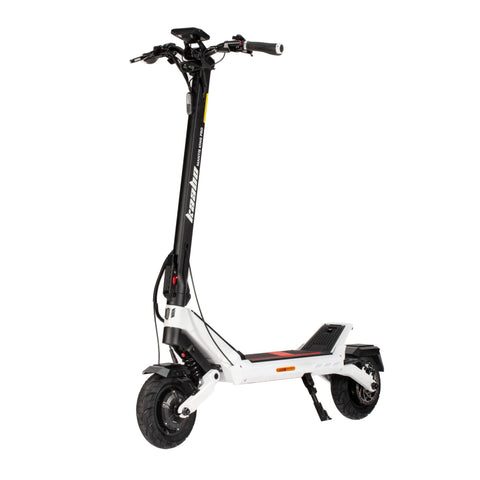
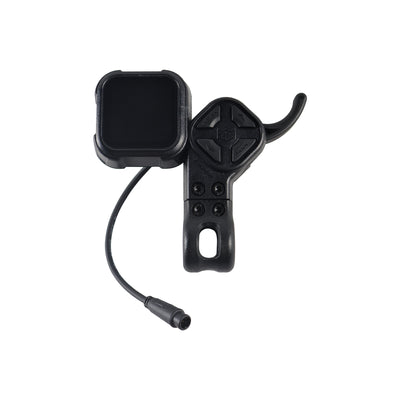
Daily features favor the Mantis King Pro too. It pairs a 3.5-inch color smart display with app control, a dual-lock folding mechanism, and DMEGC 21700 cells rated for long cycle life. The forged aluminum frame supports riders up to 265 pounds. The Phantom 2.0 counters with a higher 300-pound limit and Apollo's HEX display, which appeals to heavier riders.
For most commuters, the Mantis King Pro's higher water sealing, app features, and dual-lock fold add up to an easier scooter to live with. Heavier riders who need the extra 35 pounds of capacity are the clearest case for the Phantom 2.0.
Mantis King Pro vs Apollo Phantom: The Price and Value Verdict
The Mantis King Pro delivers more scooter per dollar, landing at $1,599 against the Phantom 2.0's $1,994 to $2,136. For $400 to $540 less, the Mantis King Pro adds a removable battery, standard hydraulic brakes, a higher-voltage 60V system, and faster charging. That value gap sits at the core of the Mantis King Pro vs Apollo Phantom decision.
Kaabo also backs the Mantis King Pro with up to 18 months of coverage, ahead of the 12-month warranty Apollo lists as standard, plus U.S.-based support. Buyers can compare every Kaabo model side by side or review the warranty details before ordering. Riders who want a lighter, cheaper pick can look at the Kaabo Mantis 8, while those chasing more speed and range can step up to the Mantis King GT.
The Phantom 2.0 remains a strong scooter. Its 41 mph top speed, 300-pound rider limit, and refined build earn their fans. But those gains cost several hundred dollars more, and they arrive without a removable battery or standard hydraulic brakes. For value-focused commuters, that trade rarely makes sense.
Add it up, and the Mantis King Pro wins the matchup for most riders: similar performance, better everyday hardware, and a materially lower price.
Frequently Asked Questions
Is the Apollo Phantom 2.0 faster than the Mantis King Pro?
Yes. The Apollo Phantom 2.0 reaches a tested 41 mph, while the Mantis King Pro tops out at 37 mph. Both use dual 1200W motors, so the difference comes from tuning. In the Mantis King Pro vs Apollo Phantom race, the Phantom wins top speed, yet 37 mph already exceeds most legal street limits.
Does the Mantis King Pro have a removable battery?
Yes. The Mantis King Pro uses a 60V 18Ah battery with a mechanical key-lock release, so riders remove it and charge it indoors without lifting the scooter. The Apollo Phantom 2.0's 52V pack sits fixed inside the deck. For apartment riders, that removable design is a major everyday advantage.
Which scooter has the longer range?
The Mantis King Pro claims up to 50 miles under Kaabo's test, with a 176-lb rider at about 16 mph. Independent testing of the Apollo Phantom 2.0 returned around 37 miles in range mode at a similar speed. So the Mantis King Pro leads on range, though both figures drop at higher speeds.
Is the Mantis King Pro cheaper than the Apollo Phantom 2.0?
Yes. The Mantis King Pro costs $1,599, while the Apollo Phantom 2.0 runs $1,994 to $2,136 depending on the brake trim. That makes the Mantis King Pro about $400 to $540 cheaper, even though it includes hydraulic brakes and a removable battery as standard equipment.
Are these scooters legal to ride on public roads?
Legality depends on local law, since most areas cap street and bike-lane speeds at 15 to 20 mph, well below either scooter's top speed. Riders should check state-by-state electric scooter laws before riding the Mantis King Pro or the Apollo Phantom 2.0 on public streets.
Which scooter is better for daily commuting?
For daily commuting, the Mantis King Pro is the stronger pick. Its removable battery, standard hydraulic brakes, IPX6 battery sealing, and app-connected display suit riders who charge indoors and ride in all weather. The Apollo Phantom 2.0 fits riders who prioritize a slightly faster top speed and higher weight capacity.
The Mantis King Pro Is the Smarter Buy for Most Riders
The Apollo Phantom 2.0 wins on two numbers: a 41 mph top speed and a 300-pound rider limit. Those specs matter to speed chasers and heavier riders. For nearly everyone else, though, the Mantis King Pro delivers the better overall package.
At $1,599, it undercuts the Phantom 2.0 by several hundred dollars while adding a removable 60V battery, standard hydraulic brakes, faster charging, and stronger water sealing. Those features solve real daily problems, from charging in an apartment to stopping safely in the rain. Backed by up to 18 months of coverage and U.S.-based support, it also carries less ownership risk.
Ready to see it in person? Shop the Kaabo Mantis King Pro.
Related reading: